
The build guide · affiliate marketing for beginners · 6 phases
Build an affiliate site – from idea to first payout.
The whole build plan on one page: niche, tech, content in an age when AI does the heavy lifting, programmes, links, traffic and optimisation. No "earn DKK 10,000 in your sleep" – but the order that works, with checklists you can tick off as you go.
Live exampleRunning example: denbedsteluftrenser.dk – a Danish site we run ourselves. Real decisions, real lessons.
6 phases24 checkpoints8 key insights30-day plan5 mistakes to skip
First: what you are getting into.
An affiliate site is not an income you switch on – it is a curve you build. Here is the shape of the first twelve months, as they actually unfold for a site that bets on search traffic:
The shape is what matters: nothing happens in the first months, and then suddenly something does. The curve depends on the niche – but the turning point almost always comes after the point where it stopped being fun.
Key insight
Most people give up in month 3 – exactly when the work starts to pay off
Google spends months deciding whether a new site is worth showing. During that period your effort looks completely fruitless: the same zero visitors, however good the articles are. That is not a sign that the niche is wrong – it is the wait everyone pays.
The practical consequence: decide in advance how many articles you will write BEFORE you allow yourself to judge the result. Twenty is a fair number. If you judge after five, you close a site that never got its chance.
Choose a topic you can stick with.
The gold zone
People want to buy, and nobody answers properly yet. This is where you want to be.
“Best air purifier for the bedroom”
Requires authority
The money is there, but page 1 is taken by big sites. Come back in a year.
“Best mobile phone”
Traffic without money
Readers come, but buy nothing. Good for a blog, bad for affiliate.
“What does humidity mean?”
Avoid
Fierce competition for readers who are not going to buy anything. The worst of both worlds.
“Indoor climate news”
The most common cause of affiliate death is not tech or traffic – it is a topic you get bored of after three weeks. A niche site has to be fed for months before it pays back, so the topic has to pass two tests: you can write 30 pages about it without forcing yourself, and people buy something once they have read about it.
- Buying intent: the topic must have products people research before buying – "best X for Y", "X or Z", "X review". Hobby topics without products bring readers, not commission.
- Check the competition before you choose: search for your own future headlines. If page 1 is full of thin template pages, there is room. If it is full of thorough test pages, choose a narrower angle – or another topic.
- A topic you use yourself: experiences, photos of the product in your own living room and mistakes you made yourself are the content neither competitors nor AI can copy.
The niche on denbedsteluftrenser.dk is air purifiers: products with heavy research (allergies, noise, filter prices), room for commission in the price – and seasonal peaks every time pollen counts and virus season hit the news.
Broad – everyone writes about it
Narrower – fewer can answer
Your angle – this is where you can win
Checklist
0 / 4
Saved only in your browser
Pillar
Best air purifier 2026
The broad page everything links to
Allergies & asthma
HEPA, pollen, pet hair
Bedroom
Under 25 dB
Large rooms
Living rooms, open plan
Budget
Under DKK 1,000
Notice the split: the clusters are situations people recognise themselves (“I have allergies”, “it is going in the bedroom”) – not technical specifications. People search for their problem, not for your columns.
Key insight
Segment by situation – not by specification
The most common structural mistake is to divide the site the way the manufacturer divides its catalogue: by filter type, wattage, capacity. But nobody searches for “HEPA H13 380 m³/h”. They search for “air purifier that is quiet in the bedroom”.
Build your subpages as answers to situations – allergies, bedroom, large room, tight budget. Same products, different entry question. That is also why the cluster model above works: each subpage can rank for its own situation and send the reader on to the broad comparison.
Tech in an afternoon – not a month.
The tech choice matters for a reason few people say out loud: it decides where your time goes. Every hour spent on plugins and themes is an hour that did not become content – and the content is the only thing that makes money.
- WordPress is still the default choice: free, everything exists as a plugin, and hosting costs from about DKK 500–1,000 a year including the domain. Choose a fast, boring theme and never touch it again.
- Site builders (Webflow, Framer and the like) are quicker to make pretty, but more expensive per month and harder to move away from. Fine for a few pages – heavy for 100 articles.
- Code it yourself (Next.js and the like) gives full control and top speed, but is only a shortcut if you are already a developer. Both this site and denbedsteluftrenser.dk are built that way – and it took longer than a WordPress setup.
- Whatever you choose: HTTPS, fast hosting, a simple home page and a structure where every article has its own address. An affiliate site needs no more tech than that to start.
Checklist
0 / 4
Saved only in your browser
Key insight
Choose a boring theme, and freeze it
Design is the most satisfying way to avoid writing. It feels like work, it can be redone endlessly, and it moves nothing: nobody has ever decided not to buy an air purifier because the font was the default.
Give yourself one afternoon, choose a fast theme, and promise yourself not to touch it again before article number twenty. Speed matters to both readers and Google – aesthetics only much later.
The 'old' domain that turned out to be new
denbedsteluftrenser.dk lives on a domain that had a life before us. The plan was classic: buy an expired domain with history, and skip the queue. It did not work out that way – the old links were effectively gone, and Google treated the domain as brand new, just with an old name.
The lesson: check a used domain’s history on archive.org and its link profile BEFORE you pay extra for the "age". A domain without live links pointing to it is not old – it is just used.
Content in the age of AI: drafts are free, responsibility is yours.
This is the phase that has changed the most. Five years ago the bottleneck was getting things written – today AI writes a draft in minutes, and the bottleneck has moved to where it always should have been: having something to say that is correct and your own. The dividing line runs here:
AI does the heavy lifting
- Researching the topic
- Competitor analysis
- Outline
- First draft
hours → minutes
You do what counts
- Facts verified
- Your own test and photos
- Opinion and what you left out
- Published in your name
what nobody can copy
Key insight
Write about the number the advertising does not mention
The manufacturer highlights what sells. The best affiliate page highlights what the buyer regrets overlooking. For air purifiers that is CADR (how quickly the air is actually cleaned) and the filter price over three years – a machine for DKK 599 with filters at DKK 349 every six months is more expensive than one for DKK 2,000 with cheap filters.
Find that number in your own niche, and build a page around it. It is also the kind of content a language model cannot come up with by itself: it requires someone to have done the maths.
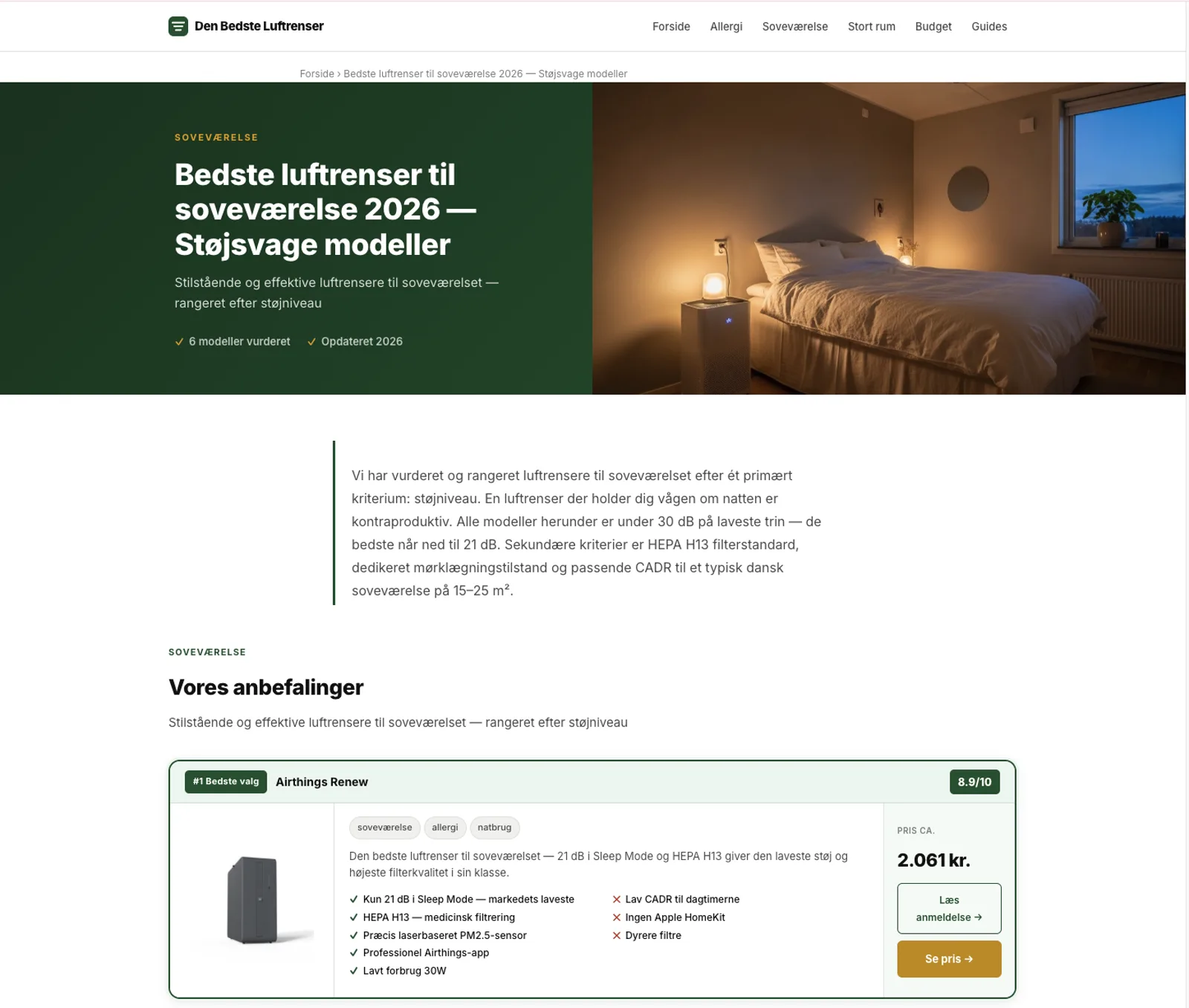
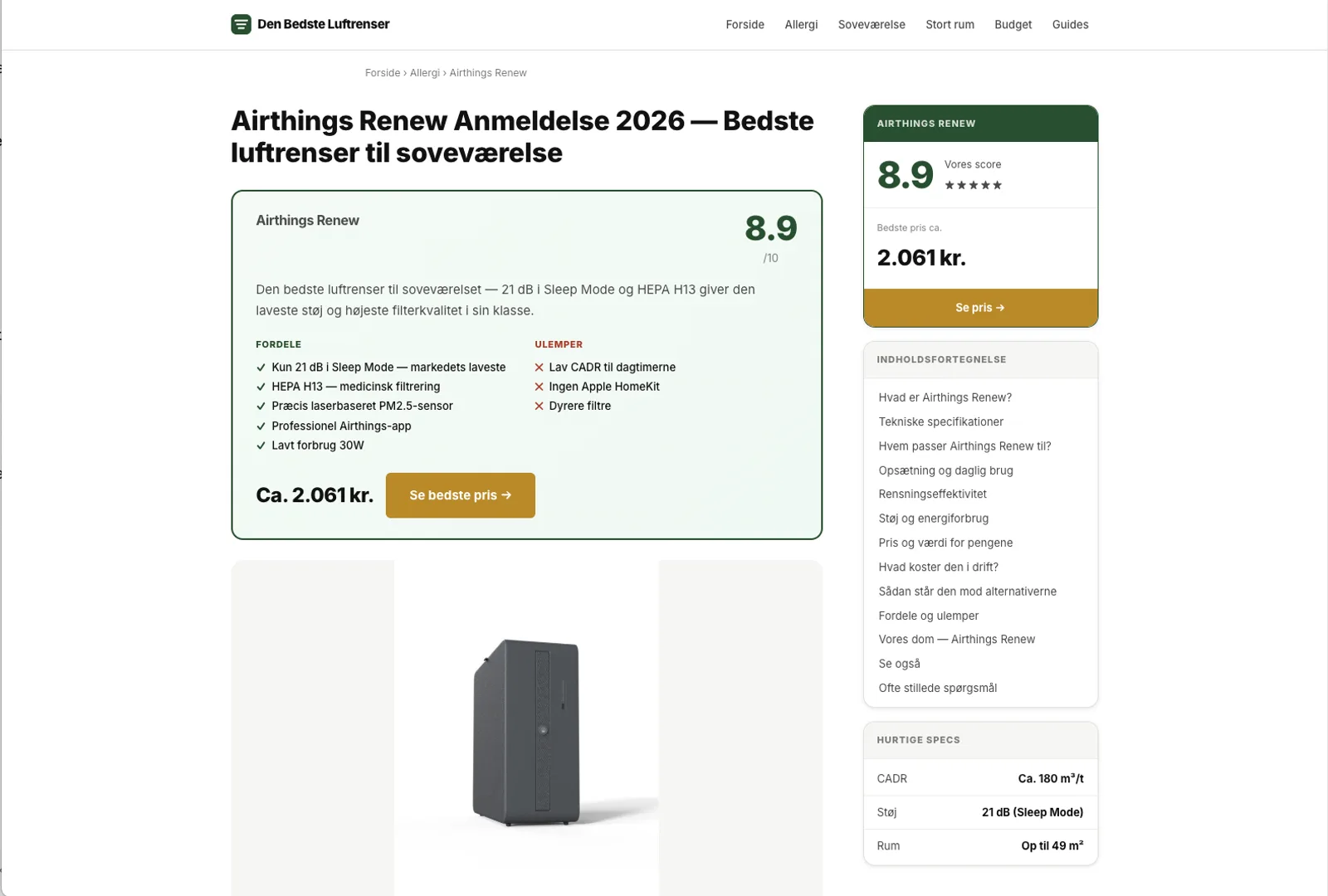
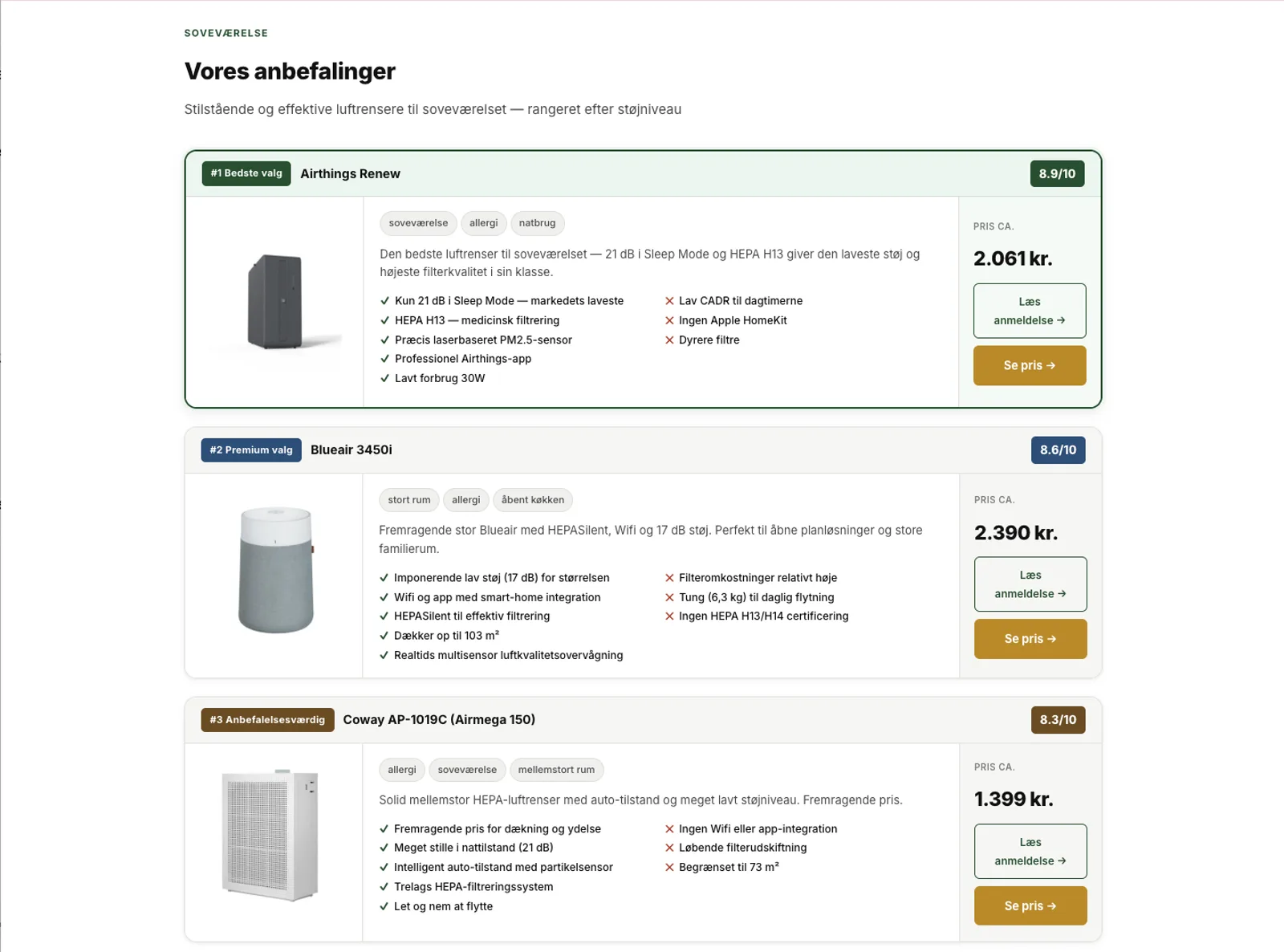
And this is what that page looks like when the work is done – with the five elements that decide whether the reader clicks on:
- 1
Title with the year
Signals maintenance. It must be right – a wrong year is worse than none.
- 2
The trust line
“Independent research · No paid placement · Local prices”. At the top, not in the footer.
- 3
Score and winner
A number and a recommendation. The skimmer should be able to stop here and be satisfied.
- 4
Comparison
Few columns, honest minuses, one price button per row. The most-clicked block on the page.
- 5
The price in the button
“See price – DKK 2,999” beats “Buy now”: it promises what happens after the click.
Research and structure: let AI do the heavy lifting
Competitor analysis, the questions people ask, outlines, feature lists for the products. That is hours of work cut to minutes, and here AI is genuinely better than doing it by hand.
Drafts: AI writes, within YOUR framework
Give it your angle, your experiences and your test notes as raw material. A draft without your own input becomes the same as everyone else can generate – and that is exactly why it does not rank.
Editing: a human stands behind every word
Facts are verified, prices and specifications are looked up at the source, and the experiences must be genuine. What you publish is yours – whoever or whatever wrote the first draft.
Maintenance: put AI to work monitoring, not just writing
Discontinued products, changed prices and dead links are what slowly kill affiliate sites. Automatic checks of that kind are the most underrated use of AI of all.
Go deeper with affiliate marketing with AI: research, prompts and analysis.
Watch out
Scaled AI content without value of its own gets penalised
Google targets mass-produced content that only exists to rank – whether it was written by AI or by people. A hundred mediocre pages lose to twenty pages where something has been tested, measured and meant. Use AI to raise the quality per page, not to multiply the number of pages.
The content types that convert are the same as ever: comparisons ("X or Y"), best-of lists with honest exclusions, in-depth reviews with your own photos, and guides that solve the problem – with the product as part of the solution. See what a content site can realistically earn from this.
Checklist
0 / 4
Saved only in your browser
Programmes, deep links and link discipline.
Now the site has to be connected to the money. Choose programmes in a network by three numbers – not by the commission rate alone: EPC (what a click has historically been worth), the approval rate (how large a share of sales actually gets approved) and the cookie window (how long your click counts). This is what the maths looks like when you put two programmes side by side:
| Metric | Programme A | Programme B |
|---|---|---|
| Commission rate | 15 % | 8 % |
| Average order | DKK 600 | DKK 800 |
| Conversion rate | 1 % | 4 % |
| Commission per sale | DKK 90 | DKK 64 |
Programme A · EPC
DKK 0.90
1,000 clicks → DKK 900
Programme B · EPC
DKK 2.56
1,000 clicks → DKK 2,560
Programme B has almost half the rate and earns almost three times as much. The rate is the headline; the conversion is the story.
And before you can compare anything at all, the traffic has to be traceable all the way. This is how visits become money:
That is DKK 0.64 per visitor. Sounds small – but it is the number everything is about. If you double the click rate by moving links up, you are at DKK 1.28 without a single new visitor.
Key insight
Move the link up before you write the next article
The click rate on an affiliate link falls dramatically with distance from the top. A link in a table above the fold gets clicked several times more often than the same link in body text further down the page – without a single new visitor.
So: once you have ten articles, an afternoon spent moving links up typically delivers more than an eleventh article. It is boring work, which is why most people would rather keep writing.
The link itself has three parts, each with a job – and the last one is the one people forget:
https://shop.com/air-purifier-pro?afid=k7f3a9&sub=toplist-no1
- The shop’s product page
- Deep link straight to the product you mention – never to the home page.
- Your click ID
- Set by the network when the click was recorded. It is what makes the sale YOUR sale.
- Your own label (sub-ID)
- Your note to yourself: which page and placement sent the click. Without it you know THAT you earn – not where.
If you build with Claude, ChatGPT or your own script, you can create links as part of the workflow. Connect your AI assistant or use Affilyflow’s REST API, choose a programme you have already joined, and insert the link with the returned html field – then the exact page comes along with every click without a sub-ID. Always use the returned URL, and open the link to check the destination before you publish.
- Always deep link: a deep link sends the reader straight to the product you mention – not to the shop’s home page. Every extra click the reader has to find for themselves costs conversion.
- Links are infrastructure: keep them in one place (a plugin or your network’s link tool), so a discontinued product is one fix in one place – not a hunt through 40 articles.
- Labelling is the law: in Denmark, pages with affiliate links must be labelled as advertising – see the Danish Consumer Ombudsman’s rules. It costs nothing; a case does.
With us the mechanics are built for exactly this workflow: deep links, channels and sub-IDs per link, and placements that show earnings per URL on your own site. The catalogue with rates, EPC and cookie windows is public – you do not need an account to do the maths.
Checklist
0 / 4
Saved only in your browser
Traffic: choose ONE channel – and win it.
The classic mistake is to be a little bit everywhere. Every channel has its own learning curve, and four half channels always lose to one whole one. Choose based on your patience and your money:
| Channel | Time to effect | Cost | Best when |
|---|---|---|---|
| SEO | 3–12 months | Time, not money | You can wait – the effect lasts and grows |
| Paid advertising | Days | Ongoing ad budget | The programme has margin, and you can do the maths per click |
| From the first subscriber | Newsletter tool | You want to OWN your audience instead of renting it | |
| Video and social | Weeks to months | Time and equipment | The topic can be shown – tests, before/after, how-to |
Paid works from day one and stops with the budget. SEO is invisible for months – and then becomes the curve that carries the site. The shape is the point; the numbers depend on the niche.
If you choose SEO – and most content sites do – the order is: tech in order, content that answers better than page 1, and then the thing everyone underestimates: links from other sites. Paid advertising requires a programme with room in the maths – and that the programme allows paid traffic; that is in the programme’s terms.
Technically perfect – and still invisible
denbedsteluftrenser.dk launched technically flawless: top speed, valid structured data, sitemap submitted. Even so, weeks went by when Google barely indexed anything but the home page. The problem was not technical – the site had 0 referring domains. Nobody pointed to it, so there was no queue to skip.
The lesson: tech is the entry ticket, authority is the queue. Start earning the first links from other sites – industry directories, listings, partnerships, mentions – in the same week you launch. Not when the content feels "finished", because it never does.
Key insight
Ask for the first link in week one
Everyone puts it off until the content is “ready enough”. But a site without links from other sites does not get assessed – it gets overlooked, and then the good articles do not matter.
Start with the easy ones: industry directories in your niche, local link directories, a guest article with someone you know, a mention from a supplier. Three real links move more for a new site than thirty new articles.
Checklist
0 / 4
Saved only in your browser
Measure everything – and optimise what exists.
From now on the work is a monthly routine, not a project. Three numbers drive it: EPC per placement (which pages earn), conversion rate per programme (are you sending traffic to something that does not sell?) and approval rate (are your sales actually approved?). How a sale becomes a payout – approval periods, pending commission and rate locks – is explained in the tracking guide.
- Move links up: placements above the fold and in tables typically convert best. Measure it with sub-IDs instead of believing it.
- Replace weak programmes: two programmes in the same product area can have very different EPC. The test period is cheap – you pay for it in clicks you already have.
- Update what already ranks: a page in position 6 lifted to position 3 is often a day’s work. A new page from zero is months.
- Tax from the first krone: in Denmark, commission is taxable B income – rates and thresholds are in the tax guide.
- 01Measure everything
- 02Find the weak link
- 03Fix ONE thing
- 04Wait – and measure again
Key insight
The first sale comes from a page you did not believe in
Almost everyone experiences it: the article you wrote in a hurry about something narrow is the one that starts earning – while the flagship you spent three days on sits still.
That is why sub-IDs and placement data are not pedantry. Without them you are guessing what works, and the guess is systematically wrong. Let the numbers decide what you write more of.
Checklist
0 / 4
Saved only in your browser
Five mistakes you can skip.
Each of these has cost us time or money ourselves. The difference between the wrong and the right version is rarely more than five minutes’ work – once you know you have to do it:
The link
shop.com
the home page – the reader has to find the product themselves
shop.com/product?afid=…
deep link straight to the product you mention
The button
“Buy now!”
promises an action the reader has not decided on
“See price – DKK 2,999”
says exactly what happens after the click
The title
“Air purifier test”
competes with everyone – and answers no one
“Best air purifier for the bedroom”
a situation the reader recognises as their own
The week’s work
New theme and new colours
feels like work, moves nothing
Articles 8, 9 and 10
the only thing that builds the curve
The measurement
“It seems to be going quite well”
gut feelings are systematically wrong
EPC per placement, every month
numbers that tell you what to write more of
Your first month – day by day.
Everything above is the order and the why. This is the calendar: a realistic first month alongside a job, with the phases translated into weeks. Tick off the checklists as you go – your progress is kept in the left-hand column, waiting for you next time you drop by.
01
days 1–7
Foundation
- Choose niche and angle (the matrix in phase 1)
- Domain, hosting and theme – in ONE afternoon
- Search Console set up + sitemap submitted
- Write page 1: the big comparison
02
days 8–14
Content
- Three cluster pages: one situation per page
- Internal linking: pillar ↔ clusters
- Join 1–2 programmes that match precisely
- Deep links and sub-IDs on every mention
03
days 15–21
Depth and links
- Three reviews with your own photos
- Advertising labels on every page
- Ask for the first three links from other sites
- First look in Search Console: are the pages being indexed?
04
days 22–30
Measure and adjust
- Move links up on the most-read page
- Plan the next 10 articles based on data
- Set the article target (e.g. 20) BEFORE you pass judgement
- Repeat: the routine from phase 6, every month
Key insight
Half an hour every day beats eight hours every other Sunday
An affiliate site does not die of too little time – it dies of breaks that are too long. Google rewards sites that are updated steadily, and your own motivation survives better on small daily wins than on marathon weekends that always get postponed.
The plan above is built for exactly that: no item takes a whole day, and the order ensures there is ALWAYS something visible after half an hour’s work. Consistency is the one advantage everyone can afford.
What people ask before they start.
How much does it cost to build an affiliate site?
A domain and web hosting typically cost DKK 500–1,000 a year, and that is effectively the whole fixed cost. The rest is paid in working hours: content, links and optimisation. Signing up as an affiliate with serious networks is free.
How long does it take before an affiliate site makes money?
With SEO as the channel typically 3–12 months, because new sites have to earn authority before they rank. Paid advertising can bring sales from day one, but requires a programme with enough margin for the ad spend. The first payouts are small – the curve is what counts.
Can I use AI to write the content?
Yes. There is no requirement to declare the use of AI, and search engines assess the quality of the content, not how it was made. But the responsibility is yours: facts must be correct, experiences genuine, and mass-produced AI content without value of its own gets hit by Google’s rules on scaled content.
Do I need a company registration to run an affiliate site?
Not to get started. In Denmark, as a private individual you declare the commission as B income (income without tax deducted at source). If the activity becomes regular and professional, or turnover approaches the VAT threshold, you have to register a business.
How many affiliate programmes should I join?
Start with 1–3 programmes that match your topic precisely, and assess them on EPC and approval rate rather than the commission rate alone. More programmes only make sense once you have enough traffic to compare them on your own numbers.
Read on
Where to next
Documentation and further reading
- What does a Danish affiliate site earn?The formula behind the earnings and 3 worked examples.
- Passive income7 ideas with honest estimates of effort, capital and maintenance – from affiliate sites to digital products.
- Affiliate marketing with AIResearch, content and analysis with an AI assistant as an affiliate.
- DocsPage trackingSee exactly which page on your site each click came from – with the HTML code or placement.js.
Phase 04 is waiting
The site is the plan – the programme is the money.
The catalogue is public: rates, EPC and cookie windows can be checked before you sign up. And the affiliate gets exactly the rate shown – the fee is part of the shop’s total price.